My lessons from "Same as Ever"
You and your grandpa wrestled with the same problems; only the stage props were different.

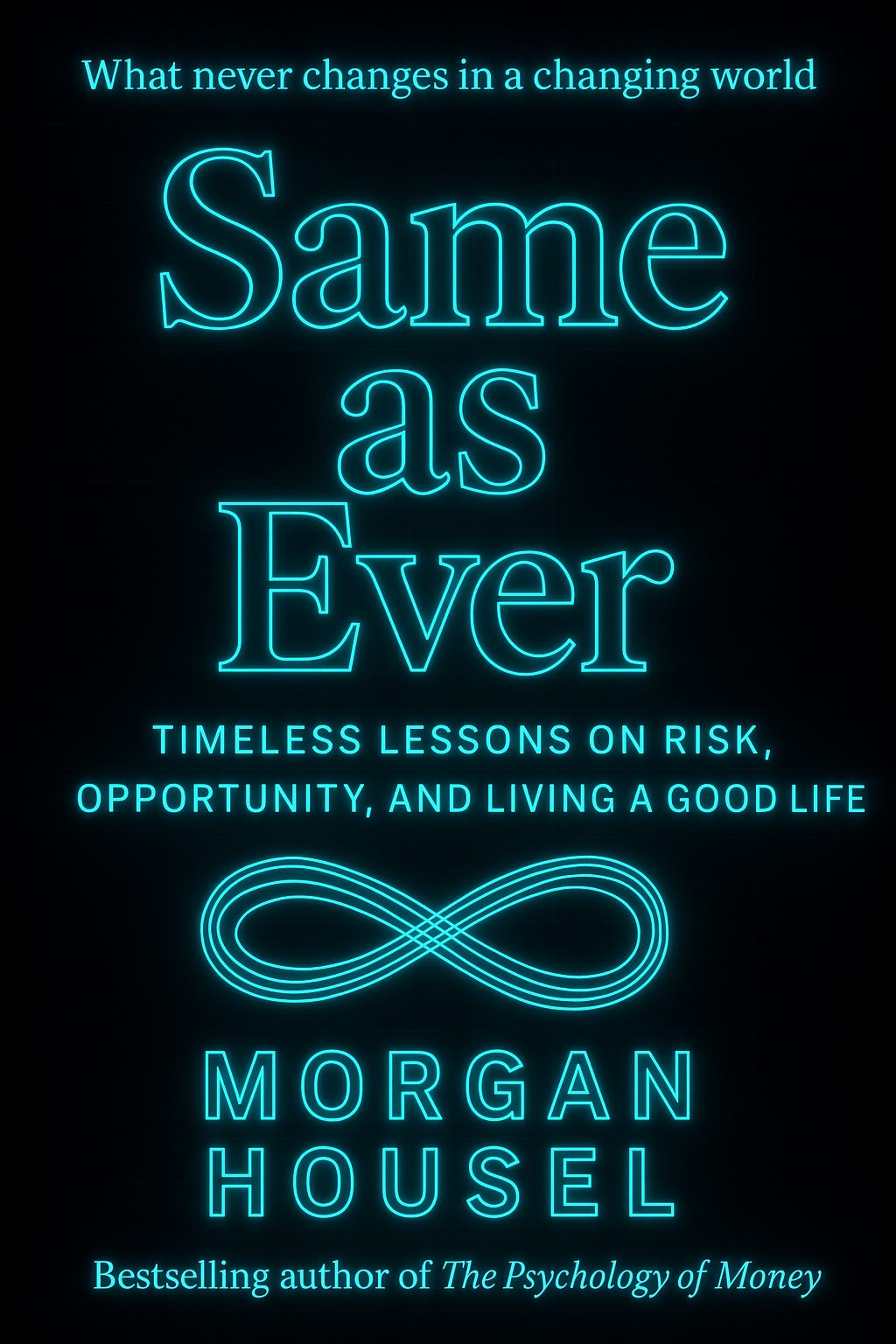
I picked up Same as Ever as an inflight read and before I knew it, I had finished this sermon on the instincts hardwired into us which serve a reminder that History doesn’t repeat itself, but people do. And that’s all what really needs to be known.
I distinctly remember in 2021, at 19 The Psychology of money was a newfound gospel for me and its predictable fan club of overtly ambitious, impatient and overconfident teenagers (I sincerely hope the glaze of premature wisdom doesn’t go past college). Picking up Housel again brought a sheepish grin on my face and it felt like graduating from the starter pack to the deeper truths he really wanted us to see.
It would have been a sheer waste to read it merely as a pastime, so I decided to pen down new learnings — both as a way to absorb and brainstorm for myself as well as an attempt to spark thoughts in your mind. Above all, this is my first foray into compiling something more elaborate, under the useful pressure of public scrutiny. I have taken the liberty to depart from contextual points and include some of my learnings from recent period for the greater good.
Key Takeaway
Is the Path to Happiness merely cutting down on things you worry about and is GenZ getting this wrong? Our anxieties shift with the apps we open. Yet somehow as soon as you achieve or obtain something u were obsessively working towards, new mental obligations/burdens along with new set of competitors spawn and here we go again…
What’s really not gonna change in the next decade?
We spend so much time asking what’s next that we forget to ask what never leaves. Housel reminds us that across centuries, people have battled the same turbulent emotions— greed that consumes, envy that unsettles, fear that cripples, pride that blinds & tribal loyalty that both comforts and confines. There is no playbook, only individuals chasing their own version of happiness with the same fragile tools.
The idea that what lies in front of us is a dark hole of uncertainty can be so intimidating, it’s easier to cope with the opposite—that we can see the future, and that its path is logical and predictable. Rather than always attempting to figure out little ways the future might change, study the big things the past has never avoided.
You don’t have to have it all figured out or worry about being the smarter person. Be an active thinker & observer, have crazy, wild kinds of ideas—counterintuitive but ultimately true because often they’re easiest to overlook. In 2025 where AI is old news and AGI is the cool kid on the block no one really knows which professions would become redundant. But here’s the paradox: the faster the world changes, the more valuable it becomes to focus on the few things that don’t. Those are the ones which people tend to miss.
What history truly teaches?
Often how an event ended and somewhat a plausible explanation to what could have led to the immediate start but rarely the true point of origins get uncovered. Housel put forth his point by making a casualty chain on the 2008 financial crisis which made me deduce my own chain:
What caused the Harshad Mehta scam? The loopholes in India’s banking system (the misuse of Ready Forward deals and fake bank receipts). What caused those loopholes? A regulatory framework decade behind its markets, where outdated settlement systems met weak oversight. What made the scam so irresistible? The greed of investors chasing overnight riches as stock prices soared. What fueled that greed? A society brimming with ambition but long starved of genuine wealth creation opportunities.
Why was India starved? Years of socialistic governance that throttled private enterprise and kept capital markets shallow. What led to that governance? A newly independent nation scarred by colonial plunder — left poor, uneducated, and deeply distrustful of free markets.
And what caused that plunder? Centuries of colonialism.
And what caused colonialism? Europe’s relentless appetite for resources and control…... and this chain can go on endlessly.
What is risk?
Risk is what’s left over after you think you’ve thought of everything. No policymaker foresaw that a virus would bring India’s economy to a standstill in a matter of days. Before the Adani saga no investor believed a single report could wipe out over $100 billion in market value almost overnight.
Nassem Taleb’s book ‘Black Swan’ really deepened not only my understanding of a Black swan event but also my reactions to their aftermath— a highly improbable event that truly has unexplainable origins, carries a massive impact and feels explainable in hindsight.
A recent personal event felt unfathomable. Yet it etched a lesson into me:
It’s always the surprises that bring about an inflexion point in your life and reinforced that you can’t even trust yourself at times. You become a risk to your own self - your emotions get the best of you, why would u put blind faith in someone else but GOD?
The idea that the unseen/unexperienced might refute everything you believe just doesn’t occur to us. In the minds of a 3yr old of Hiroshima- Life was perfect as long as he has his mom, food and 1 toy. Geopolitics and war didn’t incur to his mind. Yet without any remote fault of his own, in an instant the catastrophe rewrote the course of his life.
Big risks hide inside small ones. What looks like a chain of tiny events can collapse into catastrophe.
How can we accelerate the path to contentment?
Rule #1: Keep low expectations from anyone and of anything.
When you ponder upon it, most are not driven by greed but by envy. All of us envy the end result/ the podium but never get envious of the process, efforts which went behind it. What was it that made the 2010s feel so great? Going to your hometown was adequate vaccay, birthdays were memorable when not instagramable, gifts comprised of parker pens. The gap between you and most people around you was not that large and social circles too hadn’t gotten extended virtually by means of social media. There wasn’t much social pressure to increase your expectations beyond your means.
You cannot kill Desire, you can channelise it by giving it a purpose. What we chase decides who we become.
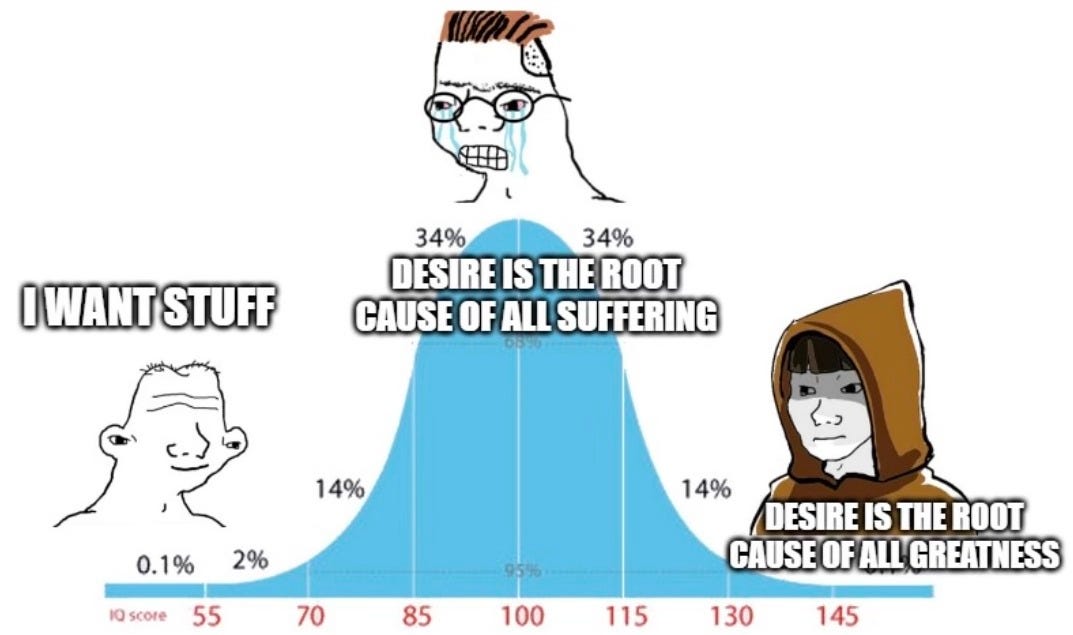
If you have to chase something chase something objective. There is no objective wealth, it’s relative to the people around you. It’s a drug…What endures is growth: the sharpening of your mind, the deepening of your skills, the resilience you build along the way, the credentials that you gain which open doors. These are the compounding forces that quietly, steadily, shape a meaningful life which ensures you don’t spiral down with midlife crisis.
What generates the emotion is the big gap between expectations and reality. Success, surprise, shock, etc. We tend to protect materialist things because we know what they cost, but notional yet core stuff like relations, health, expectations aren’t kept in check because there is no money being exchanged, we cannot forecast when our health may go for a toss, when a friend is no longer a friend and what you price you end up paying for it…..
What actually moves the Needle.
Have a Purpose and a strong moral compass: The unhappiest people drift without one. They chase distractions, delay accountability and drown their restless thoughts in shallow diversions. Because what makes life mean something is purpose. A goal. The battle, the struggle—even if you don’t win it.
Be a good storyteller: THE BEST STORY WINS- the ones which give clarity, comfort to people, which confer with their view of the world even if at the cost of rational objective ideas. The valuation of every company is simply a number from today multiplied by a story about tomorrow. Strive to be 10x the EBITDA. Be humorous- its a way to show you are smart without bragging. Deploy levity even when things are bad. In the grand scheme, even your hardest days are transient.
Protect your reputation and know where to stop- It takes twenty years to build a reputation and five minutes to destroy one. Never do anything disgraceful. it will always will catchup with you. Know what’s not worth chasing. If relationships matter, let go of the need to be right.
Yuvah Noal Harari had said “To enjoy peace, we need almost everyone to make good choices. By contrast, a poor choice by just one side can lead to war.”
Only thing harder than gaining a competitive edge is not losing an advantage when you have one - Life deals us all unique cards. The wealthy are often handed cards of capital, abundant opportunities, and mentorship shaped by proven lessons but have the burden of carrying a legacy. Those born into more austere circumstances receive a different deck— the fire within to leave a mark and the relentless discipline to persevere to cement their own legacy. Both paths demand strategy, but the stakes are shaped by the hand you’re dealt. Success will be measured from where you started and where you landed eventually.
Stability is destabilising: When an economy is stable, people get optimistic. When people get optimistic, they go into debt. When they go into debt, the economy becomes unstable. The irony of good times is that they breed complacency and skepticism of warnings. Executives in their 40s often shift from grinding to consolidating, balancing work with family and leisure, become risk averse. Young founders, free of these weights, make speed their weapon—risk-taking and opportunity-grabbing. It’s a tension that makes the jobs of seasoned executives harder, as the Infosys–OpenAI story also shows where a founder’s reluctance to change and detachment from reality collided with a young executive’s clearer vision which would have yielded a big payoff. Success has its own gravity- The higher the monkey climbs a tree, the more you can see his ass. Even great empires fall, the Dutch and British once ruled the seas and now have drifted in relative irrelevance on the geopolitical stage.
Be on your toes : Paranoia is stressful but it focuses your attention in ways good times can’t. It kills procrastination and indecision, taking what you need to get done and shoving it so close to your face that you have no choice but to pursue it, right now and to the best of your ability.
Rational Optimism: Pessimism is more intellectually seductive than optimism and captures more of our attention. It’s vital for survival, helping us prepare for risks before they arrive but optimism is essential. best financial plan is to save like a pessimist and invest like an optimist. You can only be an optimist in the long run if you’re pessimistic enough to survive the short run. So be a Rational Optimist.
Test new limits : When a tire company develops a new tire and wants to know its limitations, the process is simple. They put it on a car and run it until it blows up.
Impatience: Don’t try to accelerate something beyond what the process can handle. The greatest impediment to creativity is your impatience, the almost inevitable desire to hurry up the process, express something, and make a splash. Have Patience to let something grow, and scarcity to admire what it grows into.
Operate like the military: Almost every major invention of our time was born with the military in mind: airplanes, vehicles, GPS, microwaves—even the internet. The military faces problems that must be solved now, with consequences as stark as life and death. Innovation is driven by incentives—fear, money, duty, war, catastrophe. Often, it’s the excess energy released from overreacting to setbacks that sparks true breakthroughs
Long term thinking might destroy the near future while you are still deluded.
Long-term thinking can be a deceptive safety blanket that people assume lets them bypass the painful and unpredictable short run. But it never does— It might be the opposite. The longer your time horizon, the more calamities and disasters you’ll experience. Sometimes your belief in the long run isn’t enough. Your partners, coworkers, friends have to sign up for the ride. You might have the guts and the will to stick out and watch things get better but what is your spouse doesn’t? What if your client, your boss doesn’t? This may come from the gap between what you believe and what you can convince other people of.
Long term thinking is easier to believe in than to accomplish. Its equivalent to standing on the base camp point to the Everest summit, convincing yourself and others (tricking your mind for the dopamine kick) “that’s where I am headed” Ok nice, but then begins the real test.
What if you built a 10year plan in 2010, only for Covid to wipe it out in 2020? There’s one long-term certainty: Death. So plan in a way that leaves you with no regrets on your deathbed and remembered with love by those who matter.
Luck factor is very understated in success.
You are prepping for your dream job but what if your interviewer comes annoyed to the interview? What if they like a quiet doer over a loudmouth. When choosing a stock you may have your numbers right, strategy right but what if there was an internal fraud or the promoter you were betting on unfortunately had an untimely death.
Nassim Nicholas Taleb has talked about how people mistake luck for skill especially in gambling, trading, and life. Few lucky survivors are visible while failures vanish, creating the illusion of skill. We overestimate talent and underplay pure randomness.
Our experiences shape our view of how the world operates. Being born into a rich family - the privilege hardwires your brain to be a bold risk taker, to strive be up a notch. This freedom of not having to follow rules applicable to everyone allows you to think unorthodoxly. This being said you use the privilege usefully and not squander by merely consuming.
Simplicity and sniffing BS
The grass is always greener on the side that’s fertilized with bullshit. It’s easiest to convince people that you’re special if they don’t know you well enough to see all the ways you’re not. Everything is sales. Instagram is full of beach vacation photos, not flight delay photos. Everyone’s dealing with problems they don’t advertise, at least until you get to know them well. Keep that in mind and you become more forgiving —of yourself and others.
Identify incentive ( while being sold and while selling)
Don’t derive dopamine kicks from your “Big idea” —They are worthless until tested. Nowadays a lott of fine gents and ladies are aligning themselves with the display of ambition over exercising ambition- appreciated when you are 16 but past college its helping nobody. Those dopamine kicks from the social validation now will lead to you spiralling out later.
Simplicity is the hallmark of truth but complexity continues to have a morbid attraction. We focus too much on cancer treatment and not enough on cancer prevention. But prevention is a boring exercise and more psychological than scientific. Asking people to quit smoking would yield a greater reduction in cancer patients but people expect billions being poured in science, new cancer research. Most of consulting industry itself is structured around churning out unnecessarily opaque solutions to create information asymmetry to justify the high fees.
Sore truth is that complexity sells better. Complexity gives a comforting impression of control, while simplicity is hard to distinguish from cluelessness. Evolution figured out its version of simplification. No “Forevermark” can sell bullshit doesn’t sell forever ;)
Decluttering and other uncomfortable truths
As soon as we fill our bucket list, we end up picking up a new bucket. New hollow experiences rarely enrich life. Observe what changes in the lives of the people you aspire to be, living one day — Will the things they have or do change anything significant about you, will the happiness endure or fade once the novelty wears off?
It’s uncomfortable to think that what you haven’t experienced might change what you believe, because it’s admitting your own ignorance. It’s much easier to assume that those who disagree with you aren’t thinking as hard as you are.
tha those who disagree with you aren’t.People think they want an accurate view of the future but what they really crave is clarity & comfort even if it costs accuracy. It’s this hunger for reassurance that often fuels conspiracy theories.
In the long run, everyone gets their moment—time proves it. In school, the toppers stood out. In college, the social butterflies owned the spotlight. Later, the quiet nerds pulled ahead with MBA admits and coveted jobs. And some win in ways less public: raising a family that loves them, a home worth returning to. Success wears many faces, and it arrives on no fixed schedule.
Imperfection
There is a huge advantage to being a little imperfect. Perfecting one skill comes at the expense of another skill that may eventually be critical to survival. Wasting time can be a great thing. Nassim Taleb says, “My only measure of success is how much time you have to kill. People who are abnormally good at one thing tend to be abnormally bad at something else. It’s as if the brain has capacity for only so much knowledge and emotion, and an abnormal skill robs bandwidth from other parts of someone’s personality.
Sometimes tunnel visionning on 1 thing, can lead to you loosing sync with the environment. The very assumptions you started out the task might have changed. The ability to zoom in and zoom out should be learnt.
If you can get your work life to a point where you enjoy even half of it, that’s amazing. Every job carries parts you won’t like—Supreme Court judges must deliver judgments that are fair but often cruel, professors shape lives and create successful students yet struggle with poor pay, and some professionals earn well but feel little fulfilment. That’s simply part of the job.
Embrace Change & Constantly focus on upside, learn
Every disruption, setback, or unexpected event carries seeds of growth if focus on what you can gain rather than what you might lose and be happy that this failure came early on. Hard-core stress leaves a scar and its these scars that teach a lot— Shake your core beliefs, force you to reinvent yourself.
If the seas were always calm, how would you ever learn to sail?
We really have no idea what policies we’ll be pushing for in, say, five or ten years. In 1930s Germany, mass unemployment and despair pushed people to vote for Hitler. Seeking a selfish, immediate escape from hardship, even at great long-term cost. Unexpected hardship makes people do and think things they’d never imagine when things are calm-it’s the cycle of problems. There is no holistic solution to ending worlds problems. In 2014 we faced issues for which Modi emerged as the solution. In 2024, the issues, the leader, the people and the nation evolved too.
Wounds heal scars last.
It’s supposed to be hard- Everything worth pursuing comes with a little pain. The trick is not minding that it hurts. Don’t be lured by shortcuts, by easier paths. The safest way to try to get what you want is to try to deserve what you want. Icons are icons because it was unfathomable to do what they did, and that we admire.
Most debates are not actual disagreements; they’re people with different experiences talking over each other. Think from their POV.
Whatever happens around you, don’t take it personally. People’s actions rarely revolve around you—they’re shaped by their own realities, struggles, and regrets. Everyone is battling their own challenges, new revelations, destiny and most of what they do is a reflection of that, not of you. Most people are dumb & not evil. By the time you are done reinventing yourself you wont even want to go back…
Above all action.
Xx-Nothing to add here , will revisit this in 10 years-Xx
Footer
The essay broadly reflects my own ideas and not a repackaging of anyone’s else thoughts. ChatGPT was used only to tune language and make it more presentable and not to alter the subject matter as that defeats the purpose.
Some points may feel very preachy and those necessarily aren’t my belief or wisdom yet but serve as a reminder for me to internalize in life.
I intend to publish monthly in a collaborative publication with my peers. In 2025, this is a chance you shouldn’t miss to spark your creativity. Either dance on Instagram or write Susbtacks. For minds that wander where most stop, the publication is an open door.